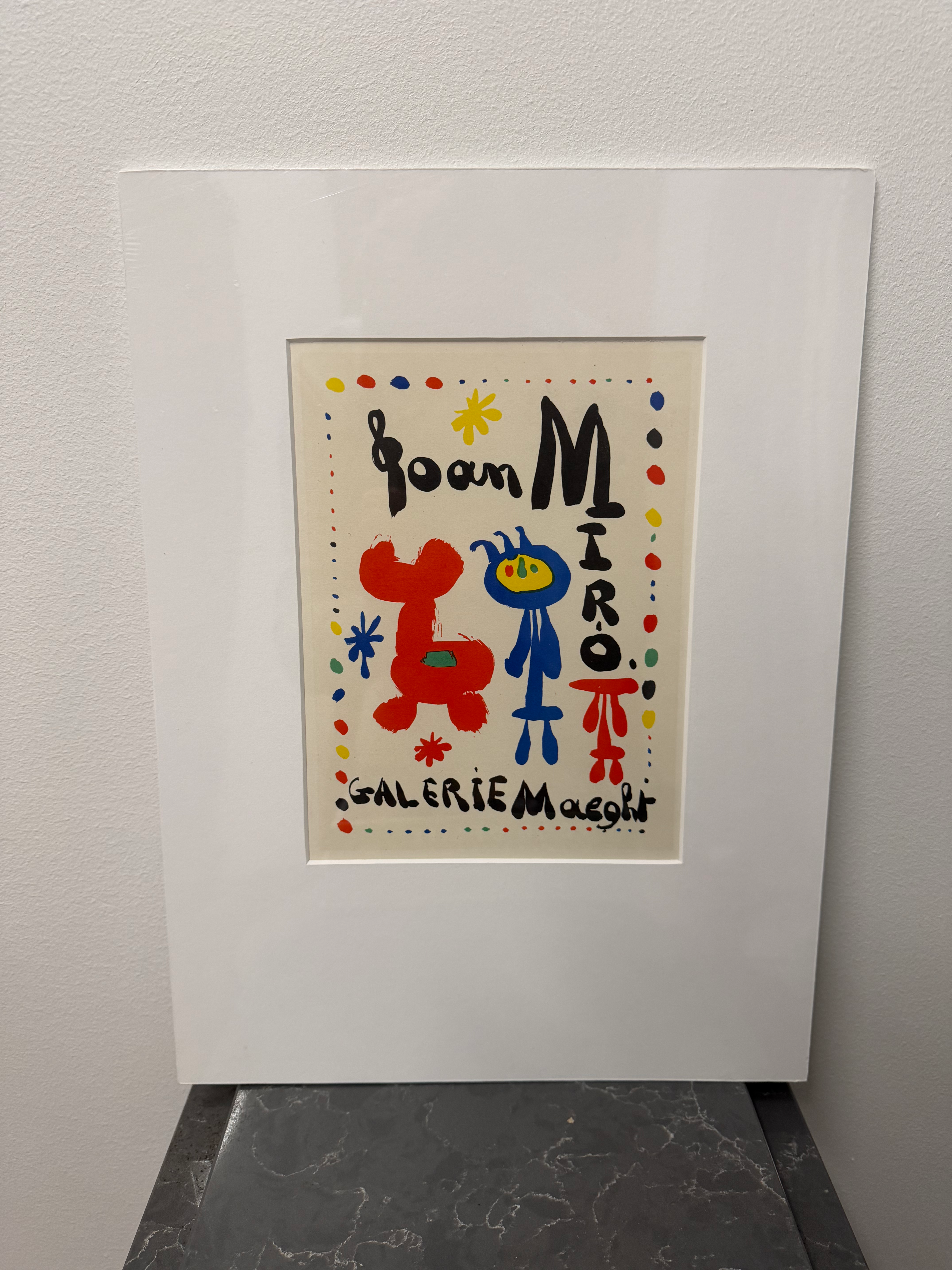

Joan Miró - Joan Miró - Galerie Maeght (1959)
Title: Joan Miró - Joan Miró - Galerie Maeght
Artist: Joan Miró
Year of printing: 1959
Publisher / Printer: Mourlot
Origin: France
Technique: Original chromolithography on paper
Size (inc. mat): 40 x 30 cm.
Size image: 21.2 x 16.8 cm.
Professionally matted in acid-free museum quality mat-board.
Joan Miró i Ferrà (1893–1983) was a seminal figure of the 20th-century avant-garde, leaving an extraordinary legacy as a painter, sculptor, and ceramicist. Born in Barcelona, his profound artistic contributions are permanently preserved in his native city at the Fundació Joan Miró, established in 1975, as well as at the Fundació Pilar i Joan Miró, founded in 1981 in his adoptive home of Palma de Mallorca. Earning global renown, his work is celebrated as a cornerstone of Surrealism—acting as a visual playground for the subconscious mind, a radical re-creation of childlike wonder, and a fierce manifestation of Catalan cultural pride. From the 1930s onward, Miró frequently expressed a deep contempt for conventional, academic painting methods, viewing them as intellectual props for bourgeois society, and famously declared an "assassination of painting" in favor of more spontaneous, experimental forms of visual expression. This rebellion led him to embrace printmaking, where his use of bold primary colours and organic, biomorphic shapes found a perfect medium.
This exquisite lithograph was produced by Mourlot Frères, the historic Parisian atelier that famously bridged the gap between commercial graphic design and fine art printmaking. Beginning in the 1930s with landmark commissions for the French National Museums—including exhibition posters for Delacroix, Daumier, and Manet—Mourlot transformed the poster into a respected collectible in its own right.
Concurrently, the workshop spearheaded a dramatic renaissance in limited-edition artist lithographs. While painters like Maurice de Vlaminck and Maurice Utrillo were early adopters at the studio, much of the avant-garde had neglected the medium during the early 1900s. This marked a sharp decline from the golden age of the 1880s, when masters like Jules Chéret, Henri de Toulouse-Lautrec, Pierre Bonnard, and Édouard Vuillard had popularised the technique originally invented by Aloys Senefelder in the late 18th century.
The studio's modern legacy was forged when Fernand Mourlot (grandson of the founder) began encouraging a new generation of painters to draw directly onto lithographic stones. This hands-on process established a unique, highly collaborative relationship between master printer and artist that endures today.
A watershed moment for the atelier occurred in 1937, when Mourlot pulled two promotional posters—one by Bonnard and one by Henri Matisse—for the Maîtres de l'Art indépendant exhibition at the Petit Palais. Struck by the unparalleled quality and tonal richness of the final prints, both artists immediately embraced the workshop, cementing Mourlot as Europe's premier fine art lithographer. This same year initiated a historic partnership with the visionary publisher Tériade for his iconic art review, Verve. In the post-war era, Mourlot became a vital creative hub where Matisse, Georges Braque, Bonnard, Georges Rouault, and Miró himself regularly gathered to pull experimental prints for the publication. In 1945, Pablo Picasso also chose Mourlot for his intensive return to lithography, establishing a dedicated workspace in the atelier where he would paint on stone for months on end.
In 1959, a Monte Carlo publisher commissioned a comprehensive catalogue raisonné to permanently document these celebrated art posters. Though produced in a scaled-down format, these miniature plates were printed directly by Mourlot using traditional lithographic stones (occasionally enhanced with fine offset detailing). Because of the meticulous production standards and the direct involvement of the atelier, these compact editions are highly prized by collectors and are universally catalogued as an authentic part of the artists' graphic oeuvres.
)