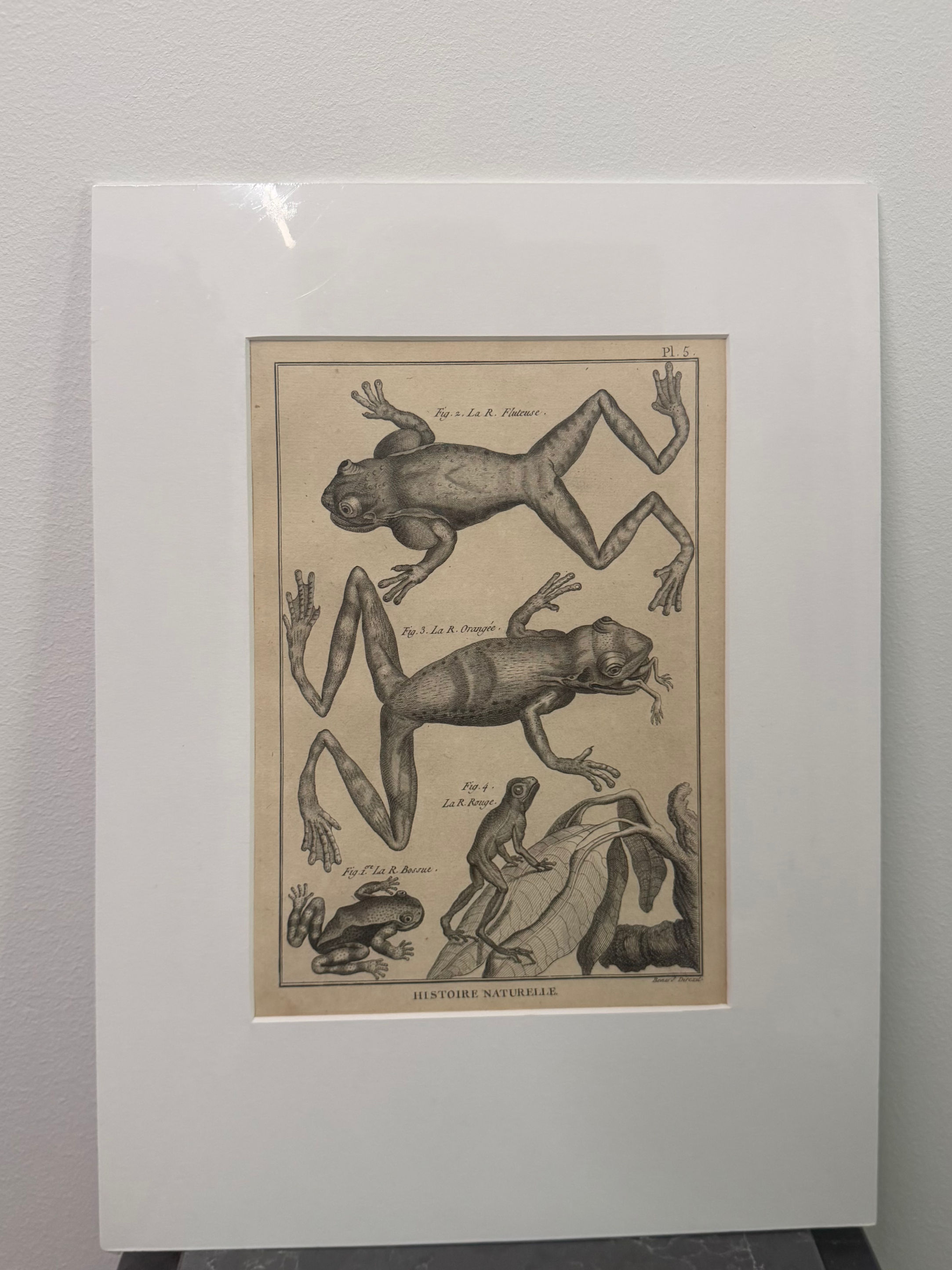

Frogs: Rusty Tree Frog, White-lipped Tree Frog, Red Snouted Tree Frog a.o. (1789
Title: "La R. Fluteuse, La R. Orangeé, La R. Rouge, La R. Bossue" (Rusty Tree Frog, White-lipped Tree Frog, Red Snouted Tree Frog, Cape Rain Frog)
Latin Name: Hyla Tibiatrix, Hyla Orangea, Hyla Rubra, Hyla Gibbosa
Engraver: Robert Bénard (1734-1794)
Year: 1789
Origin: Paris
Technique: Original copper-engraving on laid paper.
Size (inc. mat): 40 x 30 cm.
Size image: 24.7 x 17.5 cm.
Original copper-engraving, published by Pancoucke in Paris as part of a large encyclopedia on Natural History. The technique used for this print is copper-engraving. After an artist made a drawing, an engraver would transfer that image (in reverse) on a copper-plate and would engrave all the details in that plate. After the plate was inked and cleaned only the grooves of the plate would contain ink. The plate was then put under a press with a piece of hand-laid paper on top. After pressing, the ink from the grooves would be transferred to the paper. These prints would then be bound in books and served as illustrations for the text. Especially in France during the 18th century reference works on all topics covering humanity (Natural History, Architecture, Geography, Arts and Crafts a.o.) became popular amongst the wealthy. In addition during the 18th century important naturalists such as Carl Linnaeus and Georges-Louis Leclerc de Buffon published their taxonomical approaches (classification in groups or families) to the study of all things from nature. Enlightenment saw the rise of the first real 28 volume encyclopedia by Diderot and d’Alembert (and also published by Pancoucke). In addition, an geographical atlas and a reference work on Natural History was sold by the same publisher to complement the encyclopedia. The illustrations were made by Robert Bénard (1734-1794), who was a French engraver (his real name was Jacques Renaud Benard), and who had worked previously on the plates of Diderot’s and d’Alembert’s grand encyclopedia in 1751.
