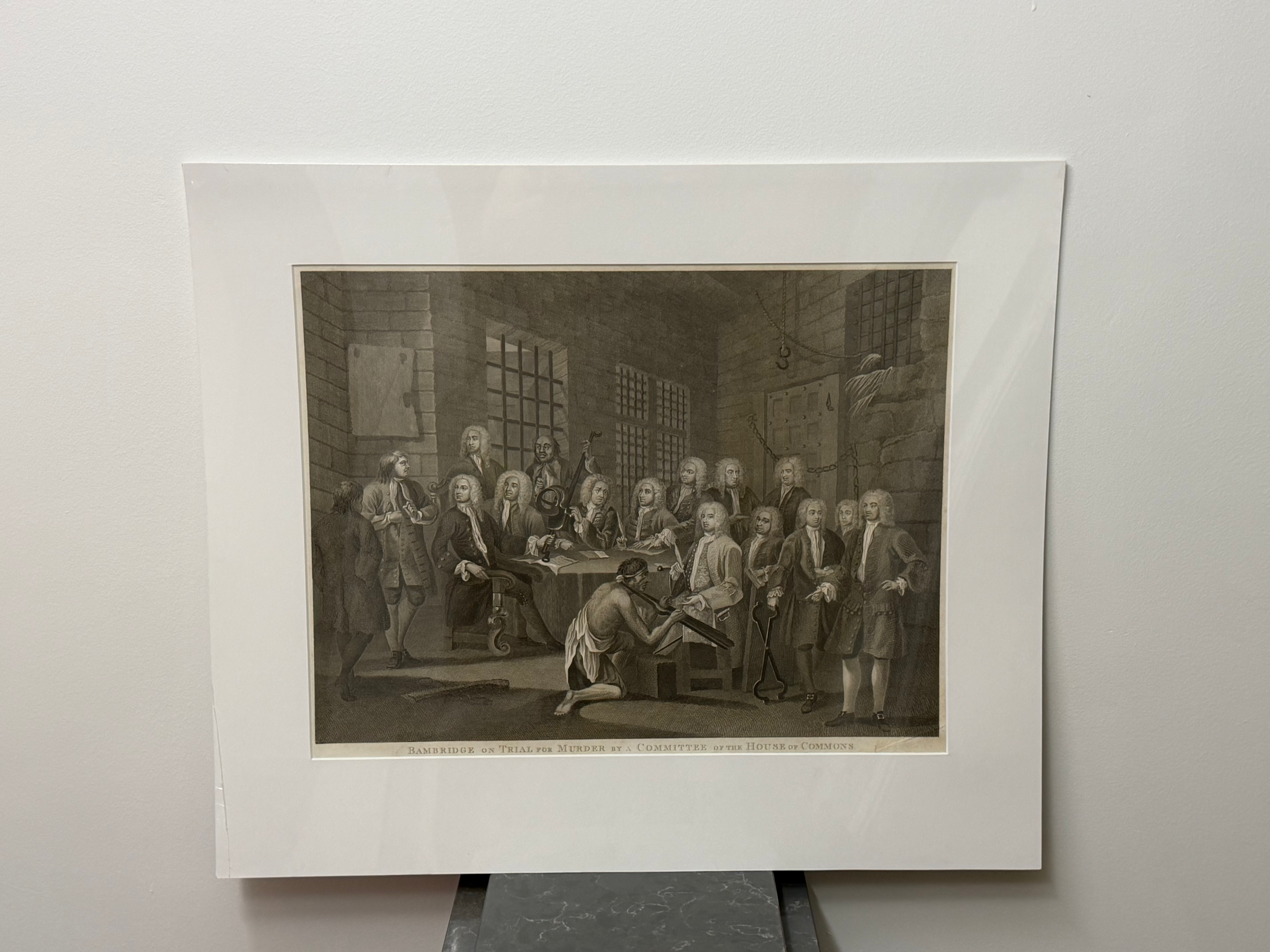

William Hogarth - Bambridge on Trial for Murder (1803)
Title: Bambridge on trial for murder by a committee of the house of commons.
Artist: William Hogarth (1697-1764)
Engraver: Thomas Cook (1744-1818)
Year of printing: 1803
Origin: London, United Kingdom
Technique: Original copper-engraving on woven paper
Size (inc. mat): 59.2 x 69.5 cm
Size image: 40.5 x 52.5 cm
Professionally matted in acid-free museum quality mat-board, lower-margin restored (not visible), sharp impression.
Artist: William Hogarth (1697-1764) was an English painter, engraver, pictorial satirist, social critic, editorial cartoonist and occasional writer on art. As an artist, Hogarth was known as a well-established portrait-painter. However, he became mostly famous as a cartoonist who (through designing and publishing prints) mocked 18th century current affairs through "modern moral subjects" depicted in a humorous / satirical way. During Hogarth's time, art became more commercialised and through the distribution / publishing of prints more accessible to a general audience. In England, the fine arts had little comedy in them before Hogarth. Hogarth's idea was: "painting and engraving modern moral subjects... to treat my subjects as a dramatic writer, my picture was my stage". Most of Hogarth's designs were re engraved by Thomas Cook (1744-1818). Cook was an English engraver and pupil of Simon Francois Ravenet. He was employed by George and John Robinson from 1795 untill 1803 to newly engrave the designs which was sold as William Hogarth's complete works.
Technique: The technique used for this print is copper-engraving. After an artist made a drawing, an engraver would that image (reversed) on a copperplate and would engrave all the details of that image in that plate. After this, ink would be applied on the plate and immediately whipped of the surface, leaving only ink in the grooves. The plate was then placed under a press with a piece of paper on top. After pressing, the ink from the grooves would remain on the paper creating the image.
Depiction: Bambridge on Trial for Murder by a Committee of the House of Commons" captures a chilling moment of real-life 18th-century justice, based on William Hogarth's original 1729 oil painting. The scene documents a historic parliamentary investigation into the horrific conditions and rampant corruption at London’s Fleet Prison for debtors. On the far left stands the accused, Thomas Bambridge, the prison's notoriously sadistic warden, looking intensely terrified and defensive as his crimes are exposed. Seated around the table are the wigged Members of Parliament, led by James Oglethorpe, who form the investigating Gaols Committee. In stark contrast to the wealthy politicians, half-starved prisoners in rags are brought forward to testify to the warden's extreme cruelty. In the center foreground, a ragged inmate vividly demonstrates the heavy iron restraints that Bambridge illegally used to extort and torture helpless debtors. Additional cruel instruments of punishment are laid out directly on the committee table as undeniable physical evidence of the prison's brutal reality. The gloomy, oppressive architecture of the prison room itself serves as the backdrop, heightening the psychological tension of the scene. Because Hogarth attended these hearings in person, he was able to capture the genuine dread and guilt on Bambridge's face with masterful precision. Since Hogarth never engraved this painting during his lifetime, this powerful image was finally brought to the print market when Thomas Cook expertly translated it onto a copper plate in 1803.
)