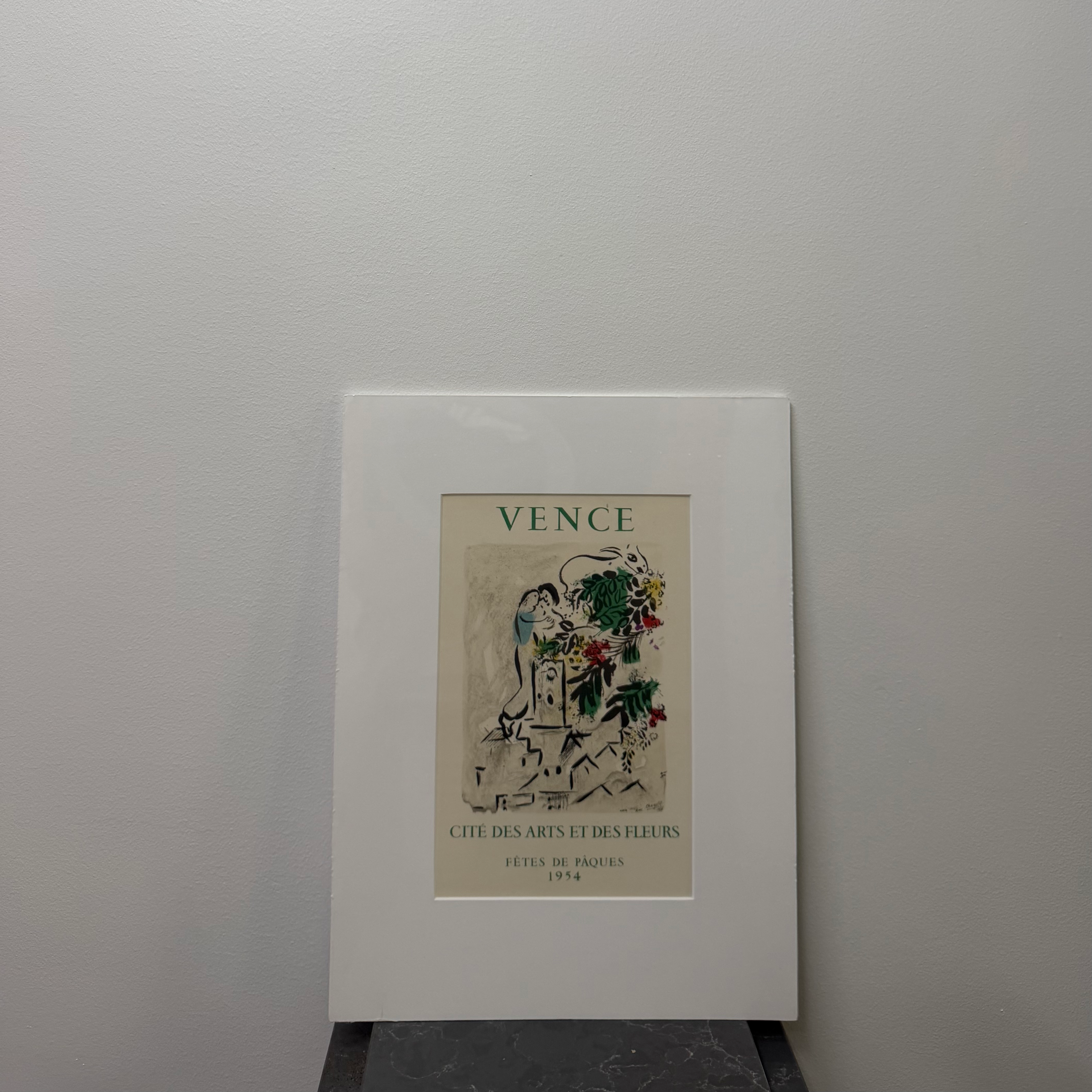

Marc Chagall - Vence Fetes de Paques - 1954 (1959)
Title: Marc Chagall - Vence Fetes de Paques - 1954
Artist: Marc Chagall
Year of printing: 1959
Publisher / Printer: Mourlot
Origin: France
Technique: Original chromolithography on paper
Size (inc. mat): 40 x 30 cm.
Size image: 25.5 x 16.5 cm
Professionally matted in acid-free museum quality mat-board.
Marc Chagall (1887–1985), born Moïche Zakharovitch Chagalov, was a prominent avant-garde master whose poetic visual language left a lasting mark on early modernism. Emerging from a Belarusian Jewish background and later integrating into the French art world, Chagall rejected rigid stylistic boundaries, moving freely between elements of Cubism, Expressionism, and Surrealism. His immense creative energy was matched by his versatility across diverse artistic formats; beyond his celebrated canvases, he designed monumental stained glass windows, theatrical stage sets, tapestry designs, and ceramics, while maintaining an exceptionally rich practice in book illustration and fine art printmaking.
The execution of this lithograph was entrusted to Mourlot Frères, the legendary Parisian printing house that fundamentally altered graphic art history by treating the commercial exhibition poster as a serious creative medium. Beginning in the 1930s with beautifully struck posters for major retrospectives of Delacroix, Daumier, and Manet at the French National Museums, Mourlot demonstrated that promotional prints could be elevated to autonomous works of art.
Alongside this public-facing work, the workshop championed a major renaissance in fine art, limited-edition lithography. In the early decades of the 20th century, the technique had largely lost its appeal among mainstream painters, despite having reached an extraordinary peak in the 1880s when figures like Jules Chéret, Henri de Toulouse-Lautrec, Pierre Bonnard, and Édouard Vuillard embraced the method originally devised by Aloys Senefelder in the late 1700s. Early twentieth-century exceptions at Mourlot included Maurice de Vlaminck and Maurice Utrillo, but the wider artistic community remained detached from the medium.
The dynamic shifted decisively when Fernand Mourlot (grandson of the atelier's founder) began inviting avant-garde figures directly into the printshop to draw on lithographic limestone. This hands-on ethos initiated an unprecedented, deeply symbiotic alliance between painter and master printer that continues to define the medium today.
A defining moment arrived in 1937 when the studio pulled promotional posters for both Bonnard and Henri Matisse to mark the Maîtres de l'Art indépendant exhibition at the Petit Palais. Deeply impressed by the remarkable fidelity and depth of colour achieved by the workshop, both artists established a permanent relationship with the firm, securing Mourlot’s status as Europe’s premier fine art printer. That same year saw the start of a legendary partnership with publisher Tériade for his iconic art review, Verve. Following the Second World War, the workshop served as a vital creative laboratory where Matisse, Georges Braque, Bonnard, Georges Rouault, and Joan Miró regularly collaborated to produce important graphic sequences. In 1945, Pablo Picasso also selected Mourlot for his intensive return to printmaking, establishing an active presence in a corner of the workshop where he would work on stone for months at a time.
In 1959, a Monte Carlo publisher commissioned a comprehensive catalogue raisonné to formally record these celebrated exhibition designs. Although scaled down from the original posters, these smaller plates were printed directly by Mourlot using traditional lithography (augmented occasionally by subtle offset details). Because of the strict adherence to the studio's rigorous technical standards, these compact editions are highly sought after by collectors and are universally recognized as authentic components of the artists' graphic oeuvres.
)