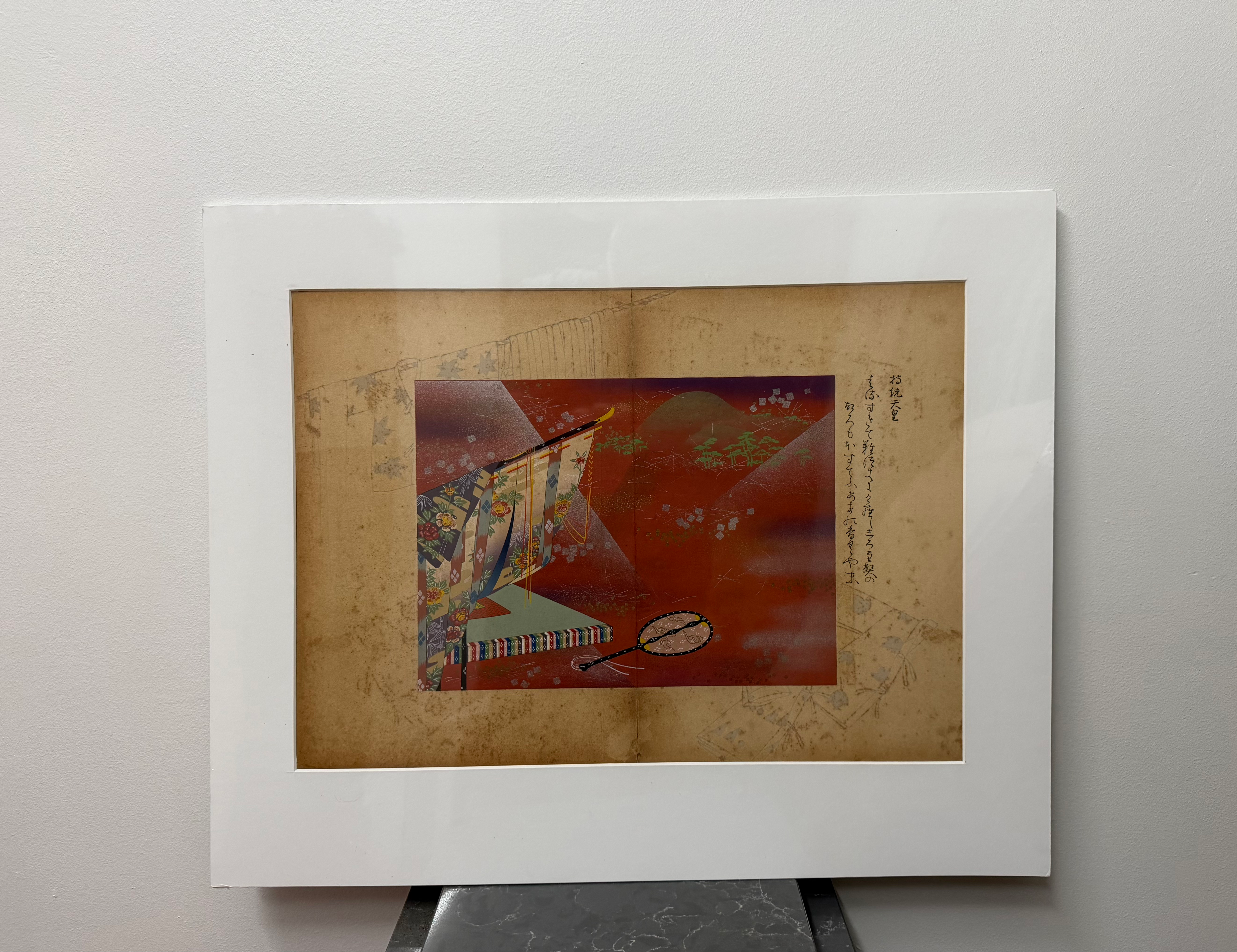

Iida Shiakiaki - Summer Weather (Poem 2) - (1935 - 1937)
Title: Summer Weather (Poem 2)
Artist: Iida Shiakiaki (Shikô) (born: 1896-1969)
Year of printing: 1935-1937
Origin: Kyoto: Japan: Unsodo, Showa 10-12 [ Year of printing: 1935 -1937 ]
Technique: Original ukiyo-è (multicolour woodblock print)
From: Hyakunin Isshu Zuko Ogura no Nishiki (Deisngs inspired by the Hyakunin Isshu, Brokade of Ogura)
Size (inc. mat): 46 x 57 cm
Size image: 32 x 45 cm
Professionally matted in acid-free museum quality mat-board, with fold as issued (reinforced professionally with japanese paper at the back), foxing.
Iida Shiakiaki (Shikô) (born: 1896-1969). The Hyakunin Isshu is a collection of 100 poems compiled by Fujiwara no Teika (1162–1241). The calligraphed texts of these poems were intended as decoration on traditional Japanese screens inside the Ogura mansion of a wealthy relative. Over the centuries, famous ukiyo-e artists such as Moronobu (17th century) and Katsukawa Shunsho (1726–1793) used the poems as a subject to produce a series of prints depicting either the poems or the poets. These images also became popular on fans, playing cards, and dressing screens.
Japanese art relied heavily (and still does) on traditional themes and techniques used for centuries. It wasn't until the 19th century, when Japan opened up to the West, that Western ideas on art (and the development of modernism) started to influence Japanese art. This continued into the 1920s and 1930s, when Art Deco in particular was greatly appreciated and incorporated into Japanese art. At the same time, Japanese artists started to uphold classical Japanese style and aesthetics using a whole new modern colour palette.
This was especially evident in fashion, pattern designs, and the Yûzen technique (a dyeing technique for fabric), developed by Miyazaki Yûzensai (17th century). With Japan's economic progress in the 19th and early 20th centuries, more demand arose for these patterns and for books by contemporary designers depicting them.
One of these designers was Sekkei Yamamoto, who was head of the design department of Marubeni-Itochu LLC in Kyoto and developed his own industrial style. One of his team members was Shiakiaki Iida (Shikô), who was born in 1899 in Osaka but raised in Kyoto, and who had a special talent for calligraphy and painting. He joined Yamamoto's team in 1919 with the aim of becoming a Yûzen designer.
In 1933, he read the book Hyakunin Isshu Lecture, which profoundly inspired him, and he decided to create a drawing of one of the scenes. These drawings were reproduced using the traditional ukiyo-e woodblock printing technique. Completing the full series took two years.
Title of the Poem on the print: Summer Weather
Text: Spring has passed, and
summer has arrived, it seems
Heavenly Mount Kagu
where, it is said, they dry robes
of the whitest mulberry!
+-+(1935+-+1937))